The Andalusian Cadence on Guitar: Play the Most Dramatic Chord Progression
Master the Andalusian cadence (Am-G-F-E). Learn the theory, variations with 7ths, and how to use it in flamenco, rock, and metal.
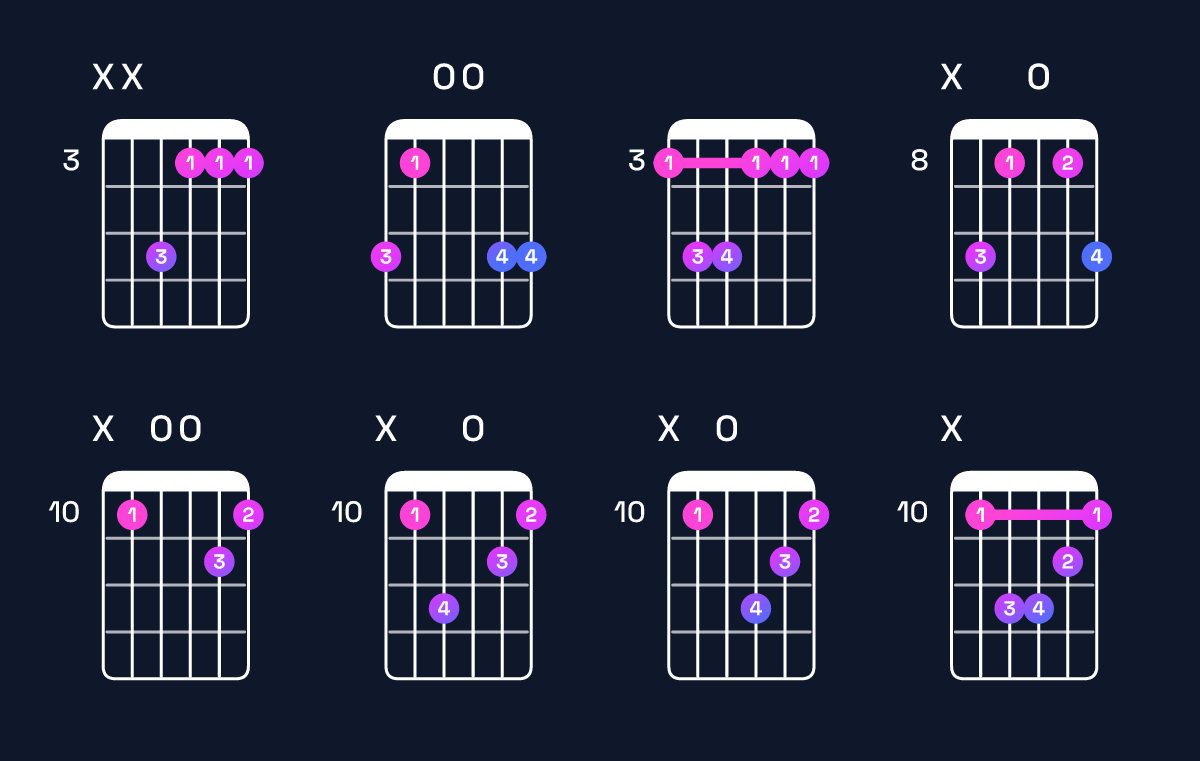
Popular fretboard positions with fingering suggestions
Showing 8 of 85 playable shapes
Gm is the G minor guitar chord. It uses the notes G, B♭, and D and the interval formula 1-♭3-5.
The G minor minor chord, composed of the root (G minor), minor third B♭, and perfect fifth D, evokes a melancholic or introspective emotion. The lowered third B♭ gives it a somber, contemplative quality, contrasting with the major chord’s brightness, and is often used to express depth and emotional complexity.
Also written as Gmin.
These are quick-start shapes for players who want the answer first and the deeper theory second.
xx5333
310033
Each note below shows how the chord is built from its root. This is the theory layer underneath the fretboard shapes.
The root anchors the chord and defines its tonal center.
This note supplies the minor color and gives the chord its darker emotional pull.
The fifth reinforces stability and gives the chord its strong harmonic frame.
Gm uses the notes G, B♭, and D. Its interval formula is 1-♭3-5.
Gm is also written as Gmin.
Place the 1st finger on the 3rd fret of the 1st string, 2nd string, and 3rd string in barre position. Place the 3rd finger on the 5th fret of the 4th string. Strum from the 4th string down.
Articles that reference this chord and explain how to use it in your playing.
Master the Andalusian cadence (Am-G-F-E). Learn the theory, variations with 7ths, and how to use it in flamenco, rock, and metal.
Master augmented sixth chords and their variations. Learn music theory and practical guitar voicings for advanced harmony.
Learn how to practice guitar effectively with backing tracks. Discover how to choose the right tracks, set practice goals, and use backing track sessions to improve your improvisation, timing, and musicality.
Discover how a guitar practice log transforms your playing by tracking progress, identifying weaknesses, and keeping you accountable and motivated.
Learn how to use borrowed chords and modal interchange on guitar. Discover how bVII, bIII, and iv chords add emotional depth to major and minor progressions with real song examples.
Move beyond open chords and first-position shapes. Learn barre chords, moveable shapes, and exercises to expand your playing up the neck.
