13th Chords on Guitar: Extended Harmony Beyond the 9th
Learn how to play 13th chords on guitar. Understand the theory, discover playable voicings for dominant 13th and major 13th, and find out how to use them in jazz, blues, and neo-soul.
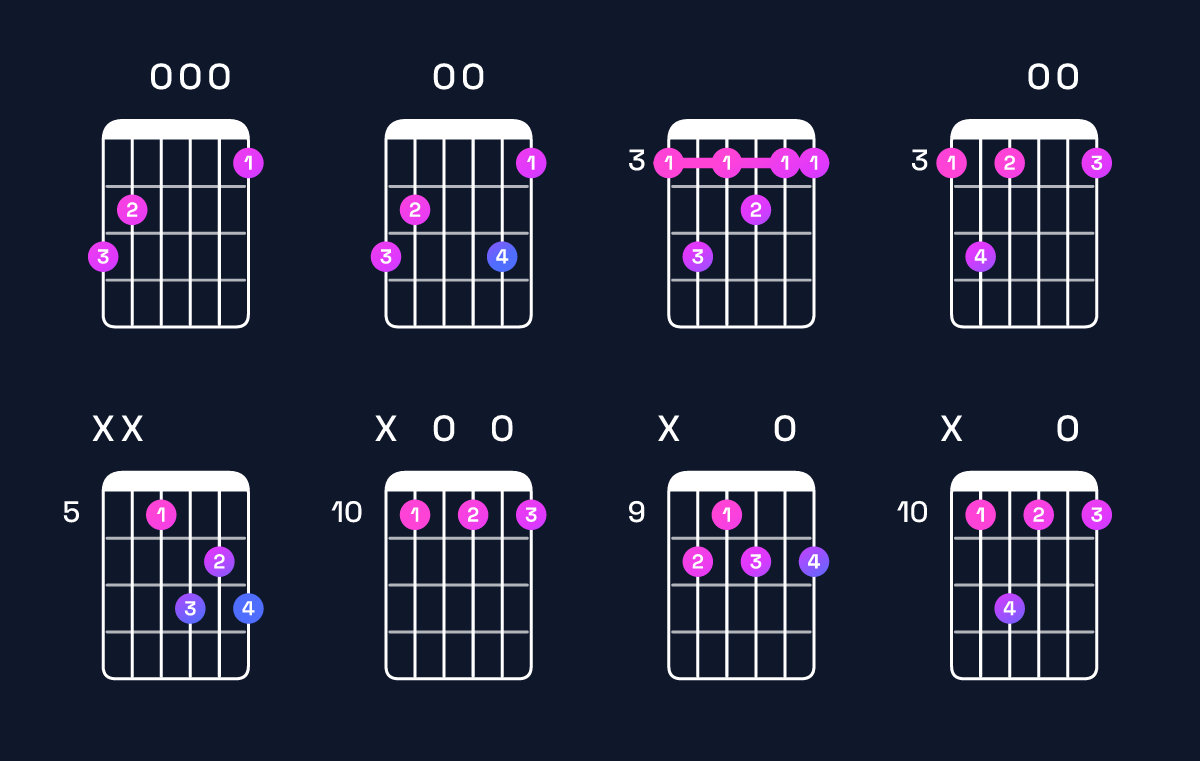
Popular fretboard positions with fingering suggestions
Showing 8 of 113 playable shapes
G7 is the G dominant 7th guitar chord. It uses the notes G, B, D, and F and the interval formula 1-3-5-♭7.
The G dominant 7th dominant 7th chord, formed by adding a minor seventh F to the major triad, creates tension that seeks resolution, typically to the tonic. The combination of the major third B and minor seventh F provides a bluesy, soulful feel, making it essential in jazz, blues, and classical cadences.
Also written as Gdom7.
These are quick-start shapes for players who want the answer first and the deeper theory second.
320001
323001
Each note below shows how the chord is built from its root. This is the theory layer underneath the fretboard shapes.
The root anchors the chord and defines its tonal center.
This note defines the chord's major quality and brings brightness to the sound.
The fifth reinforces stability and gives the chord its strong harmonic frame.
The minor seventh adds bluesy or jazzy tension that wants to move onward.
G7 uses the notes G, B, D, and F. Its interval formula is 1-3-5-♭7.
G7 is also written as Gdom7.
Place the 1st finger on the 1st fret of the 1st string. Place the 2nd finger on the 2nd fret of the 5th string. Place the 3rd finger on the 3rd fret of the 6th string. Strum from the 6th string down.
Articles that reference this chord and explain how to use it in your playing.
Learn how to play 13th chords on guitar. Understand the theory, discover playable voicings for dominant 13th and major 13th, and find out how to use them in jazz, blues, and neo-soul.
Learn 7sus4 chords on guitar - what they are, how to play them, and why they create such a powerful sense of suspended motion in jazz, funk, and pop music.
Explore altered chords as dominant seventh extensions that transform the traditional harmony. Learn the altered scale, common voicings, and when to apply them in jazz, fusion, and contemporary music.
Master the Andalusian cadence (Am-G-F-E). Learn the theory, variations with 7ths, and how to use it in flamenco, rock, and metal.
Learn how to arpeggiate chords on guitar for beautiful ballad accompaniment. Covers picking patterns, chord choices, dynamics, and creating emotional depth.
Master augmented sixth chords and their variations. Learn music theory and practical guitar voicings for advanced harmony.