Best Campfire Guitar Songs: Easy Chords That Sound Great Outdoors
Discover the best campfire guitar songs with simple chords that sound amazing. Guide to 3 and 4-chord classics perfect for groups.
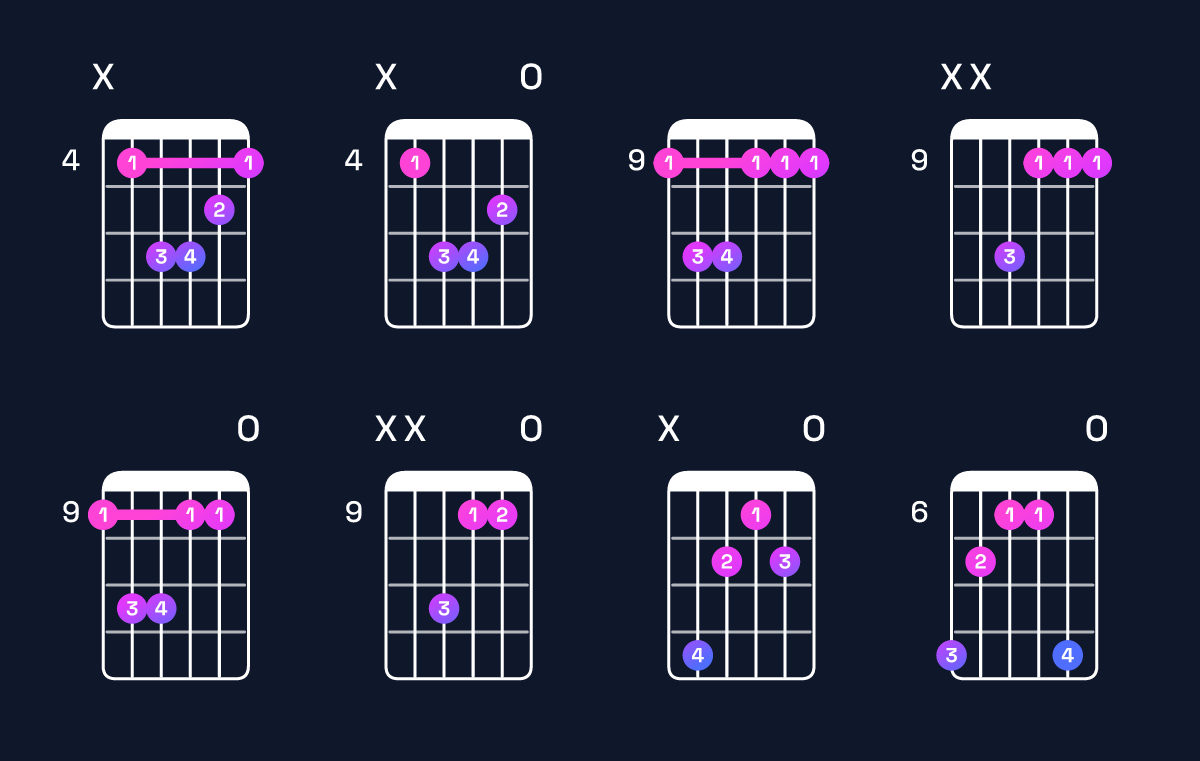
Popular fretboard positions with fingering suggestions
Showing 8 of 55 playable shapes
C♯m is the C♯ minor guitar chord. It uses the notes C♯, E, and G♯ and the interval formula 1-♭3-5.
The C♯ minor minor chord, composed of the root (C♯ minor), minor third E, and perfect fifth G♯, evokes a melancholic or introspective emotion. The lowered third E gives it a somber, contemplative quality, contrasting with the major chord’s brightness, and is often used to express depth and emotional complexity.
Also written as C♯min.
These are quick-start shapes for players who want the answer first and the deeper theory second.
x46654
x46650
Each note below shows how the chord is built from its root. This is the theory layer underneath the fretboard shapes.
The root anchors the chord and defines its tonal center.
This note supplies the minor color and gives the chord its darker emotional pull.
The fifth reinforces stability and gives the chord its strong harmonic frame.
C♯m uses the notes C♯, E, and G♯. Its interval formula is 1-♭3-5.
C♯m is also written as C♯min.
Place the 1st finger on the 4th fret of the 1st string and 5th string in barre position. Place the 2nd finger on the 5th fret of the 2nd string. Place the 3rd finger on the 6th fret of the 4th string. Place the 4th finger on the 6th fret of the 3rd string. Strum from the 5th string down.
Articles that reference this chord and explain how to use it in your playing.
Discover the best campfire guitar songs with simple chords that sound amazing. Guide to 3 and 4-chord classics perfect for groups.
Understand chord families and the I-ii-iii-IV-V-vi-vii pattern that appears in every key. Learn the common chord families for C, G, D, A, E, and F major, and how this knowledge connects to the Nashville Number System.
Explore chord progressions in the key of A with open and barre voicings for rock, country, and pop styles
Learn F# major and F# minor chord progressions. Discover barre chord shapes, capo tricks, and why songs use the key of F#.
Learn chord substitution techniques for guitar - relative minor substitution, tritone subs, diatonic substitutions, and how to use them in your own playing and songwriting.
Understand the circle of fifths and how to use it on guitar. Learn key signatures, chord families, transposing, and why it's the most useful theory tool.