
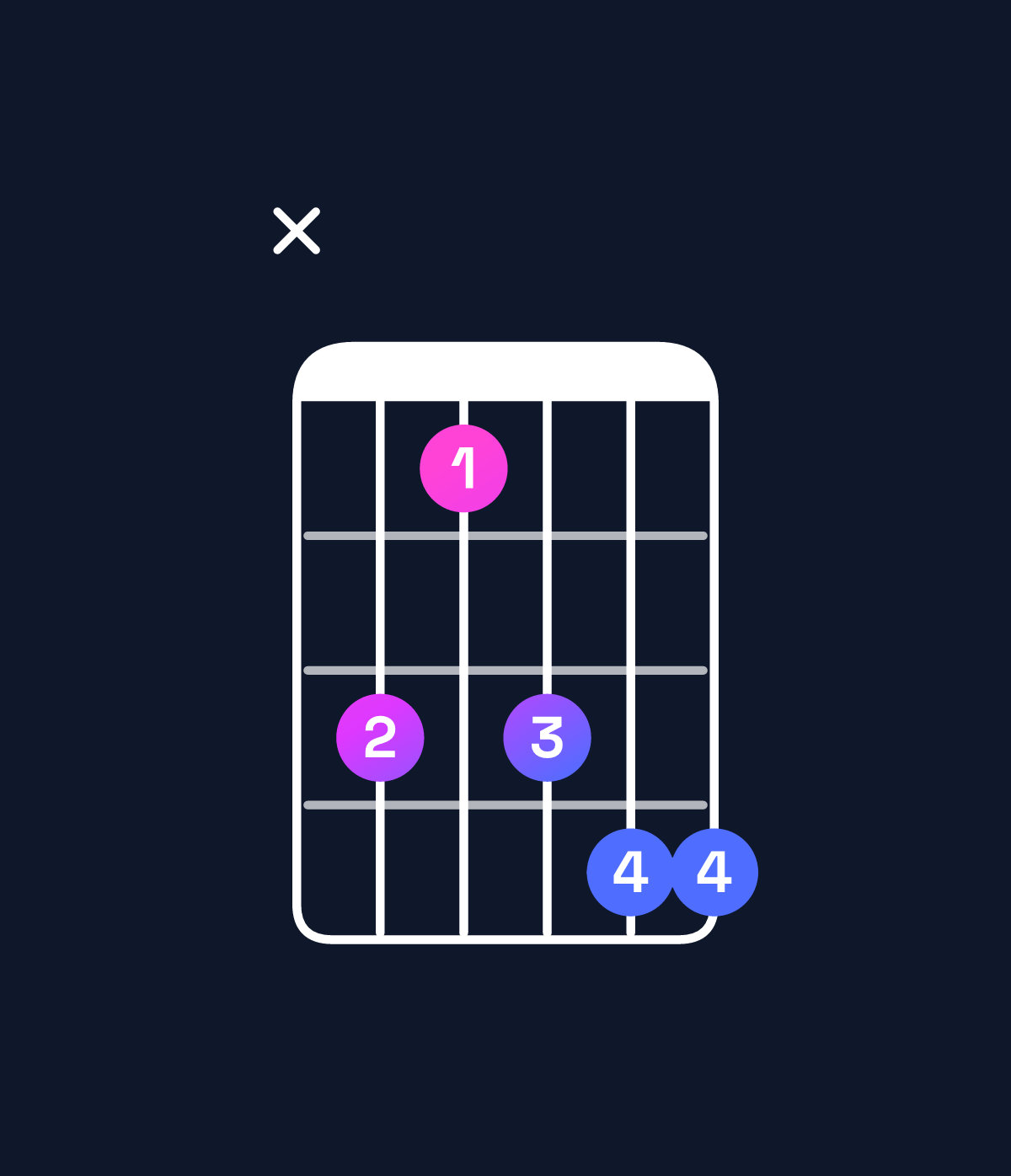
Shape characteristics
Partial barre
One finger presses two strings at the same fret. A lighter, less tiring grip than a full barre while still being fully movable.
Mid-neck · fret 4-7
Balanced tone, with neither the ringing openness of first position nor the bright snap of the upper register. Common choice for rhythm work when you want a fuller, more compact sound.
Five-string voicing
One string muted. Keeps a full low end without overlapping awkwardly with a bassist or second guitar.
Bass: E♭ · Top: C♭
The 7th (or equivalent upper tone) is in the bass, producing a suspended, leading quality that naturally wants to resolve downward.
Compared to Shape x64647 , this voicing uses a closed voicing.
How to play this shape
- 1 Place the 1st finger on the 4th fret of the 4th string
- 2 Place the 2nd finger on the 6th fret of the 5th string
- 3 Place the 3rd finger on the 6th fret of the 3rd string
- 4 Place the 4th finger on the 7th fret of the 1st string and 2nd string in barre position
Frequently Asked Questions
What does "x64677" mean?
The sequence x64677 is a highly compact guitar chord notation. It represents the fret played on each of the 6 strings, reading left-to-right from the thickest (lowest pitch) string to the thinnest (highest pitch) string: E, A, D, G, B, e.
- x means the string is muted or skipped entirely.
- 0 means the string is played "open" (without pressing over a fret).
- 1-9 represent standard fret numbers 1 to 9.
- a, b, c... represent frets 10, 11, 12, and higher (where a=10, b=11, c=12).
Can I play this G♭6sus4/E♭ shape anywhere else?
Yes! This specific layout is just one way to voice a G♭6sus4/E♭ chord. You can find all other variations in our chord shape library for G♭6sus4/E♭. Most guitarists choose different shapes based on whether they want a "brighter" or "deeper" sound, or which chord they are transitioning from.
Why do some strings have an 'x'?
Strings marked with an 'x' should not ring out. These notes are excluded because they don't belong to the G♭6sus4/E♭ chord or would clash with this specific voicing. You can mute these strings by lightly touching them with a finger that is already pressing a neighboring fret.
Other shapes
Showing 8 of 38 playable shapes