Add9 Chords on Guitar: How to Play and When to Use Them
Learn how to play add9 chords on guitar, how they differ from 9th chords, and when to use them in your playing. Includes shapes, examples, and practice tips.
Popular fretboard positions with fingering suggestions
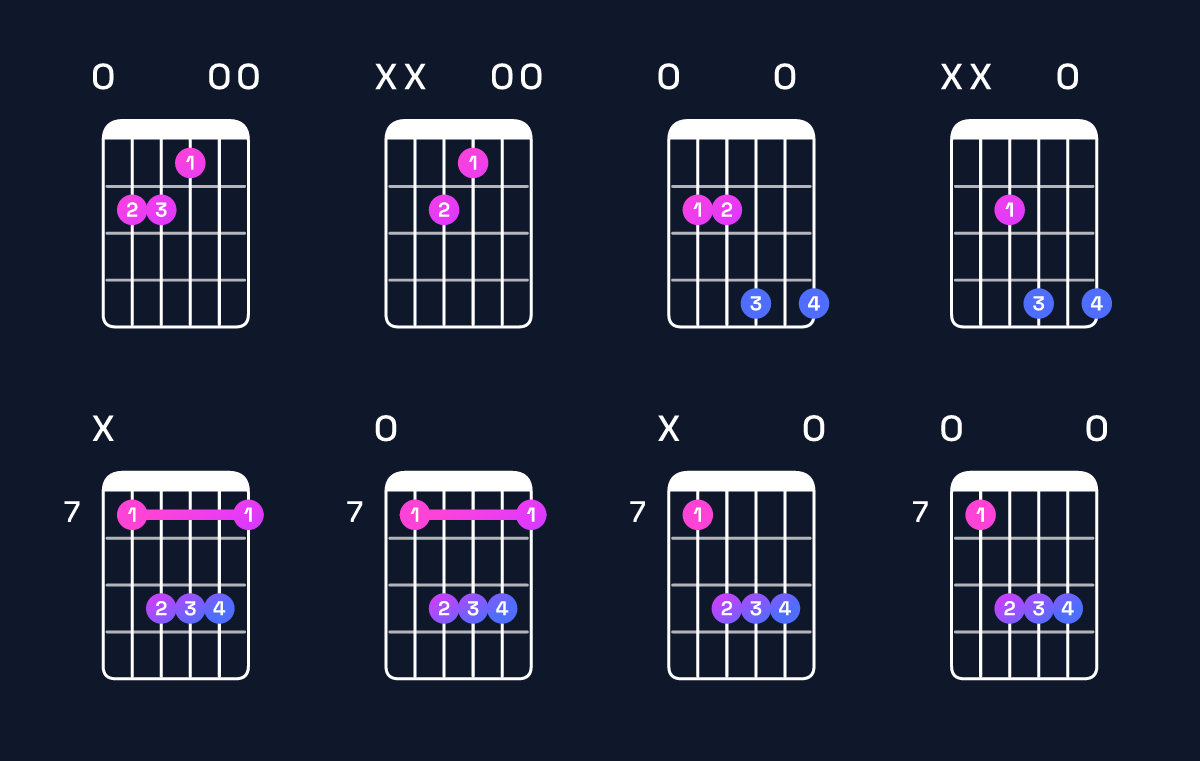
Showing 8 of 199 playable shapes
E is the E major guitar chord. It uses the notes E, G♯, and B and the interval formula 1-3-5.
The E major major chord, built from the root (E major), major third G♯, and perfect fifth B, delivers a bright, harmonious sound that feels resolved and complete. Its balanced structure makes it the foundation of Western harmony, widely used across all genres to convey joy, strength, and stability.
Also written as Emaj and EM.
These are quick-start shapes for players who want the answer first and the deeper theory second.
022100
xx2100
Each note below shows how the chord is built from its root. This is the theory layer underneath the fretboard shapes.
The root anchors the chord and defines its tonal center.
This note defines the chord's major quality and brings brightness to the sound.
The fifth reinforces stability and gives the chord its strong harmonic frame.
E uses the notes E, G♯, and B. Its interval formula is 1-3-5.
E is also written as Emaj and EM.
Place the 1st finger on the 1st fret of the 3rd string. Place the 2nd finger on the 2nd fret of the 5th string. Place the 3rd finger on the 2nd fret of the 4th string. Strum from the 6th string down.
Articles that reference this chord and explain how to use it in your playing.
Learn how to play add9 chords on guitar, how they differ from 9th chords, and when to use them in your playing. Includes shapes, examples, and practice tips.
Master the Andalusian cadence (Am-G-F-E). Learn the theory, variations with 7ths, and how to use it in flamenco, rock, and metal.
Master advanced barre chord variations including minor 7, major 7, add9, and sus voicings on guitar.
Struggling with barre chords? Learn exactly why they buzz, how to fix your technique, and a progressive practice plan to build the strength you need.
Move beyond open chords and first-position shapes. Learn barre chords, moveable shapes, and exercises to expand your playing up the neck.
Understand chord families and the I-ii-iii-IV-V-vi-vii pattern that appears in every key. Learn the common chord families for C, G, D, A, E, and F major, and how this knowledge connects to the Nashville Number System.