9th Chords on Guitar: Rich Voicings for Every Genre
Learn 9th chords on guitar - major 9th, minor 9th, dominant 9th, and add9. Shapes, theory, and how to use these lush chords in your playing.
Popular fretboard positions with fingering suggestions
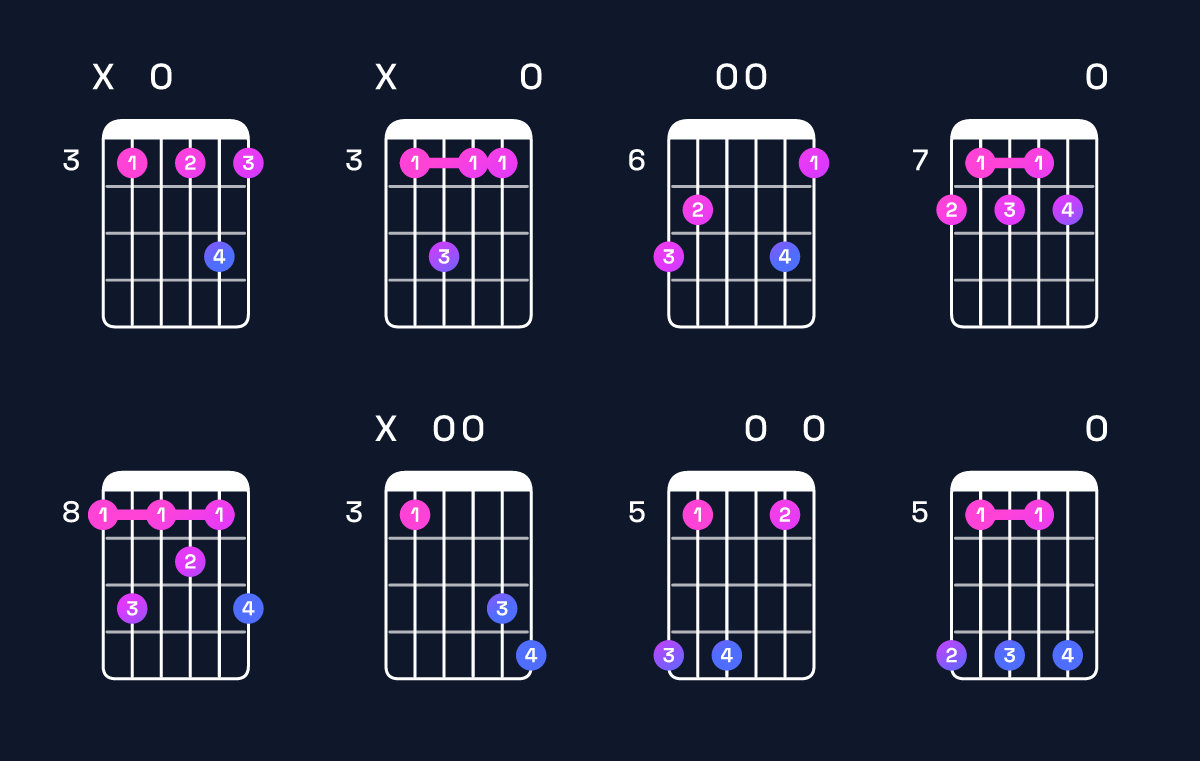
Showing 8 of 63 playable shapes
C9 is the C9 guitar chord. It uses the notes C, E, G, B♭, and D and the interval formula 1-3-5-♭7-9.
The C9 dominant 9 chord enriches the dominant 7th by adding a major ninth D, enhancing its tension with a colorful, jazzy flair. This extended harmony adds sophistication, frequently used in jazz, blues, and funk for dynamic progressions.
Also written as Cdom9.
These are quick-start shapes for players who want the answer first and the deeper theory second.
x30310
x30330
Each note below shows how the chord is built from its root. This is the theory layer underneath the fretboard shapes.
The root anchors the chord and defines its tonal center.
This note defines the chord's major quality and brings brightness to the sound.
The fifth reinforces stability and gives the chord its strong harmonic frame.
The minor seventh adds bluesy or jazzy tension that wants to move onward.
The ninth opens the chord up and adds a modern, spacious color.
C9 uses the notes C, E, G, B♭, and D. Its interval formula is 1-3-5-♭7-9.
C9 is also written as Cdom9.
Place the 1st finger on the 1st fret of the 2nd string. Place the 3rd finger on the 3rd fret of the 5th string. Place the 4th finger on the 3rd fret of the 3rd string. Strum from the 5th string down.
Articles that reference this chord and explain how to use it in your playing.
Learn 9th chords on guitar - major 9th, minor 9th, dominant 9th, and add9. Shapes, theory, and how to use these lush chords in your playing.
Learn how to play add9 chords on guitar, how they differ from 9th chords, and when to use them in your playing. Includes shapes, examples, and practice tips.
Learn how to play 11th and 13th extended chords on guitar with practical voicings. Understand what makes these chords work and when to use them in jazz, soul, and pop contexts.
Learn funk guitar rhythm technique with 16th-note strumming, ghost notes, and classic chord shapes. Covers the wah pedal approach, muting, and essential funk progressions.
Learn essential gospel guitar chord voicings - extended chords, passing chords, and the progressions that drive contemporary and traditional gospel music.
Learn the essential skills and etiquette for jamming with other musicians, from reading cues to soloing over changes, to make the most of jam sessions.