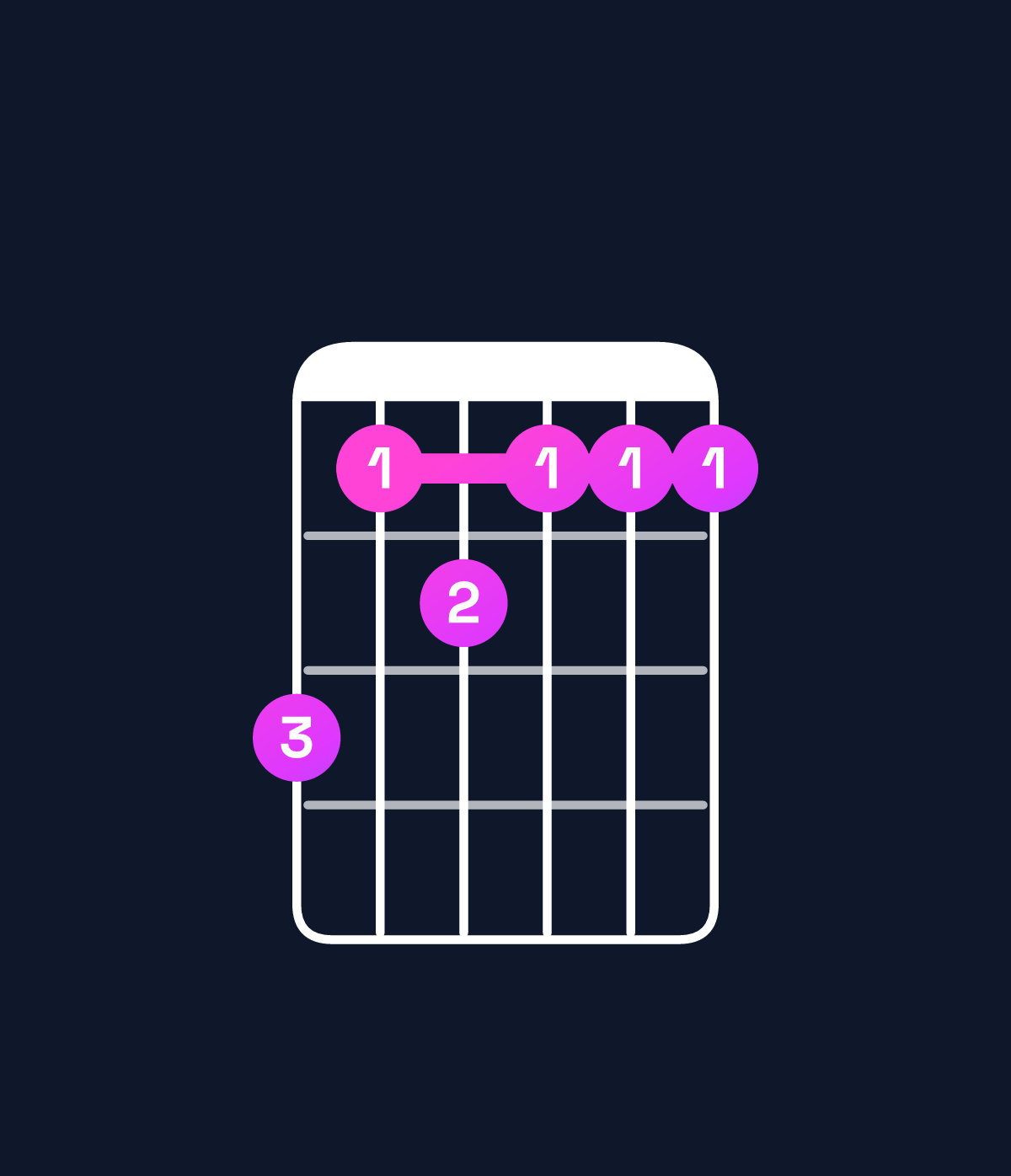
How to play C♯min/maj11/D♯ chord on guitar
Shape b9a999
Shape characteristics
Closed voicing
Every sounding string is fretted, with no open strings. Tight, controllable tone that responds well to palm muting and dynamic picking.
Upper register · fret 9-11
Brighter, more focused tone with less low-end. Works well when layering over a bassist or second guitar, and integrates naturally with lead-line phrasing higher on the neck.
Full six-string voicing
All six strings ring, giving you the biggest, most resonant version of this chord, ideal for strumming and solo acoustic contexts.
Bass: D♯ · Top: C♯
An extended chord tone is in the bass, giving the voicing a distinctive colour beyond the standard inversions.
Compared to Shape bbbbdc , this voicing uses a barre chord and sits higher on the neck (starting at fret 11).
How to play this shape
- 1 Place the 1st finger on the 9th fret of the 1st string, 2nd string, 3rd string, and 5th string in barre position
- 2 Place the 2nd finger on the 10th fret of the 4th string
- 3 Place the 3rd finger on the 11th fret of the 6th string
Frequently Asked Questions
What does "b9a999" mean?
The sequence b9a999 is a highly compact guitar chord notation. It represents the fret played on each of the 6 strings, reading left-to-right from the thickest (lowest pitch) string to the thinnest (highest pitch) string: E, A, D, G, B, e.
- x means the string is muted or skipped entirely.
- 0 means the string is played "open" (without pressing over a fret).
- 1-9 represent standard fret numbers 1 to 9.
- a, b, c... represent frets 10, 11, 12, and higher (where a=10, b=11, c=12).
Can I play this C♯min/maj11/D♯ shape anywhere else?
Yes! This specific layout is just one way to voice a C♯min/maj11/D♯ chord. You can find all other variations in our chord shape library for C♯min/maj11/D♯. Most guitarists choose different shapes based on whether they want a "brighter" or "deeper" sound, or which chord they are transitioning from.
Other shapes
Showing 3 of 3 playable shapes