Basic Music Theory for Guitar: What You Actually Need
The essential music theory every guitarist should know - notes, intervals, scales, keys, and chord construction. No fluff, just practical theory you'll use.
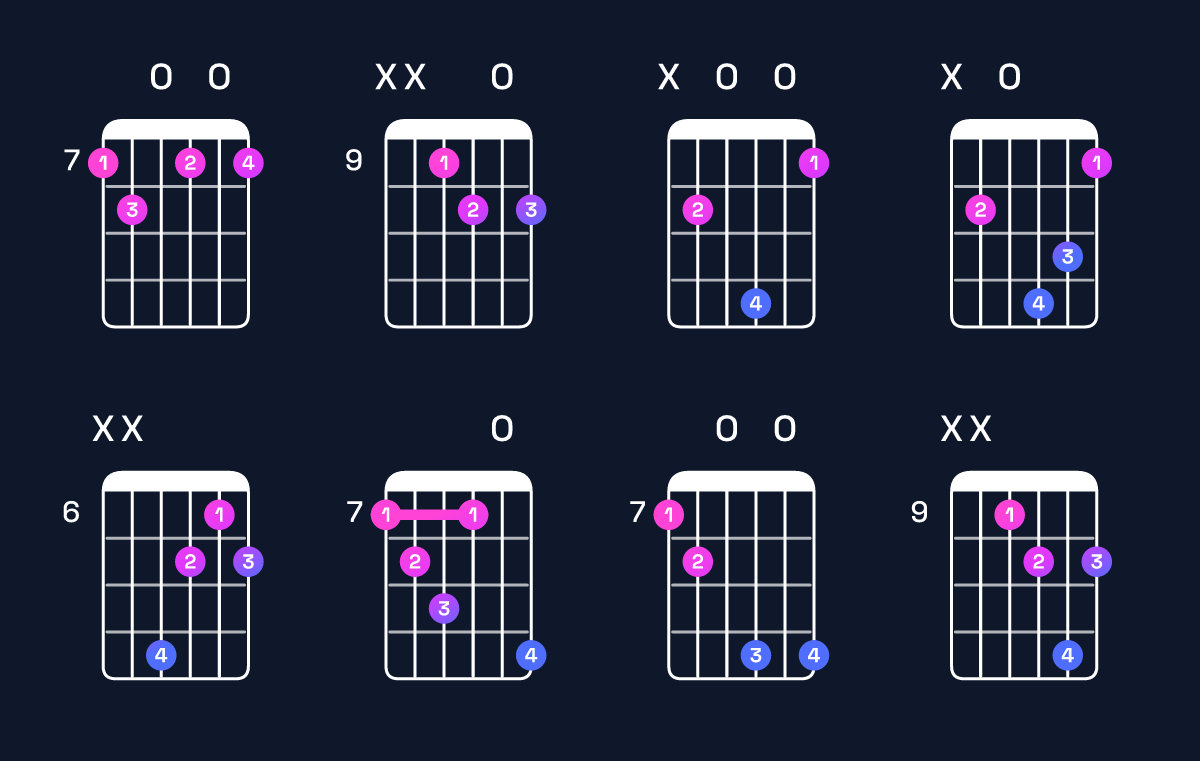
Popular fretboard positions with fingering suggestions
Showing 8 of 49 playable shapes
Bo is the B diminished guitar chord. It uses the notes B, D, and F and the interval formula 1-♭3-♭5.
The B diminished diminished chord is built from minor thirds, including a diminished fifth F, producing a tense, unstable sound. This dissonant, unresolved tension is commonly used for dramatic transitions, suspenseful moments, or eerie atmospheres in classical, jazz, and film music.
Also written as Bdim and Bm♭5.
These are quick-start shapes for players who want the answer first and the deeper theory second.
780707
xx9a0a
Each note below shows how the chord is built from its root. This is the theory layer underneath the fretboard shapes.
The root anchors the chord and defines its tonal center.
This note supplies the minor color and gives the chord its darker emotional pull.
The flattened fifth adds tension and a restless, unstable edge.
Bo uses the notes B, D, and F. Its interval formula is 1-♭3-♭5.
Bo is also written as Bdim and Bm♭5.
Place the 1st finger on the 7th fret of the 6th string. Place the 2nd finger on the 7th fret of the 3rd string. Place the 3rd finger on the 8th fret of the 5th string. Place the 4th finger on the 7th fret of the 1st string. Strum from the 6th string down.
Articles that reference this chord and explain how to use it in your playing.
The essential music theory every guitarist should know - notes, intervals, scales, keys, and chord construction. No fluff, just practical theory you'll use.
A practical roadmap for beginner guitarists ready to level up. Learn the key skills, practice shifts, and mindset changes that bridge the gap to intermediate guitar playing.
Learn how to use borrowed chords and modal interchange on guitar. Discover how bVII, bIII, and iv chords add emotional depth to major and minor progressions with real song examples.
Understand chord families and the I-ii-iii-IV-V-vi-vii pattern that appears in every key. Learn the common chord families for C, G, D, A, E, and F major, and how this knowledge connects to the Nashville Number System.
Learn how chord function creates satisfaction and tension in progressions, and why some songs feel complete while others feel unresolved.
Learn how minor key chord progressions work on guitar. Includes common patterns, diatonic chords in minor keys, and practical examples for writing emotional music.