Chord Progressions

Explore guitar chord progressions, compare fingerings, and play along with guitar, bass, and drums. Learn patterns in a musical context.

Chord progressions explain how individual chords work together. Guitar Wiz combines progression examples, chord diagrams, and accompaniment so you can hear a pattern, inspect its shapes, and practice it in a musical context.

Browse progressions by their starting chord

In the Library, switch from Chords to Chord Progressions. Explore examples with a major or minor starting chord and compare their chord sequences, genre descriptions, and diagrams. Roman numerals describe the relationship between the chords, making it easier to recognize a pattern beyond one key.

Hear the pattern with an accompaniment

Open a progression and play it with guitar, bass, and drum patterns. The playback view shows the active chord, alternative fingerings, accompaniment choices, and the tempo. Adjust the speed to suit the exercise rather than trying to match a recording immediately.
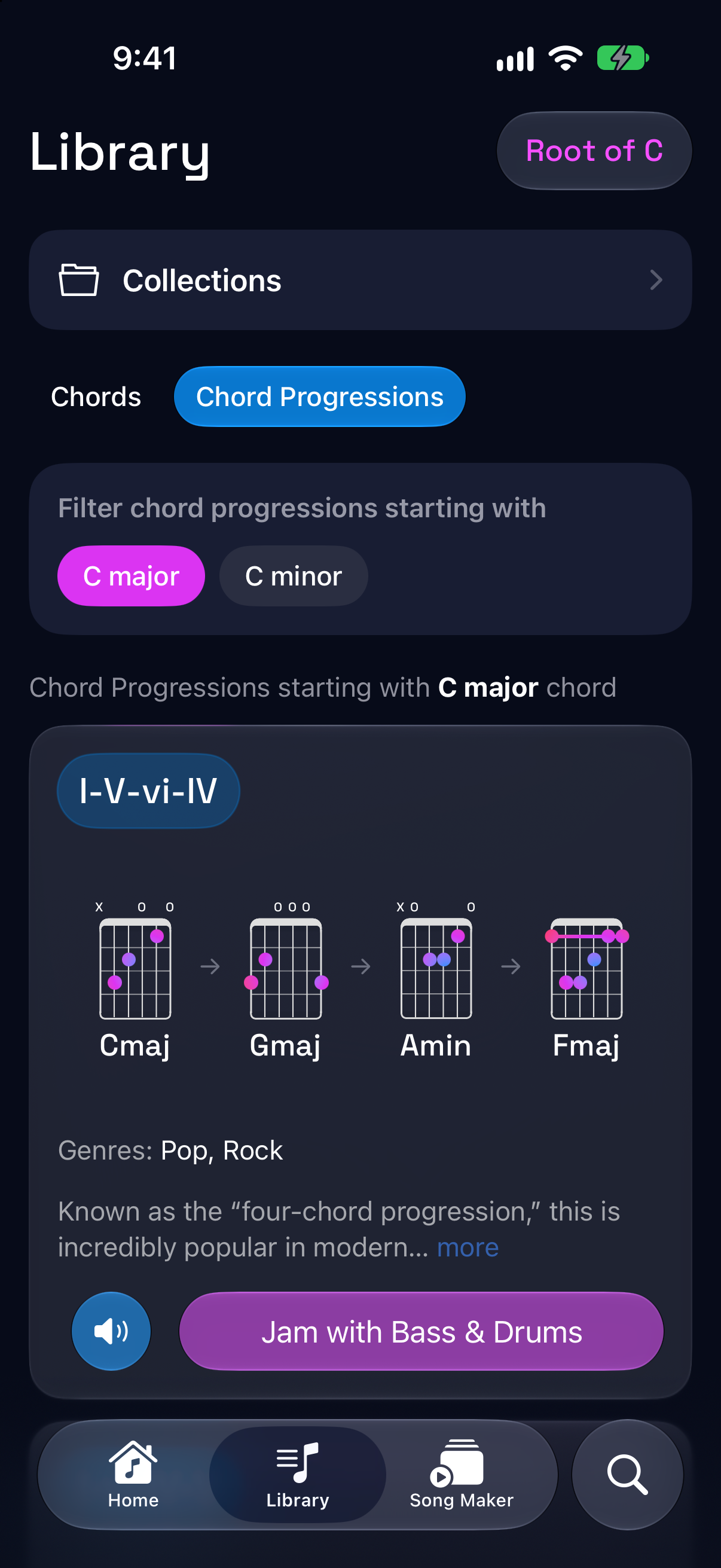
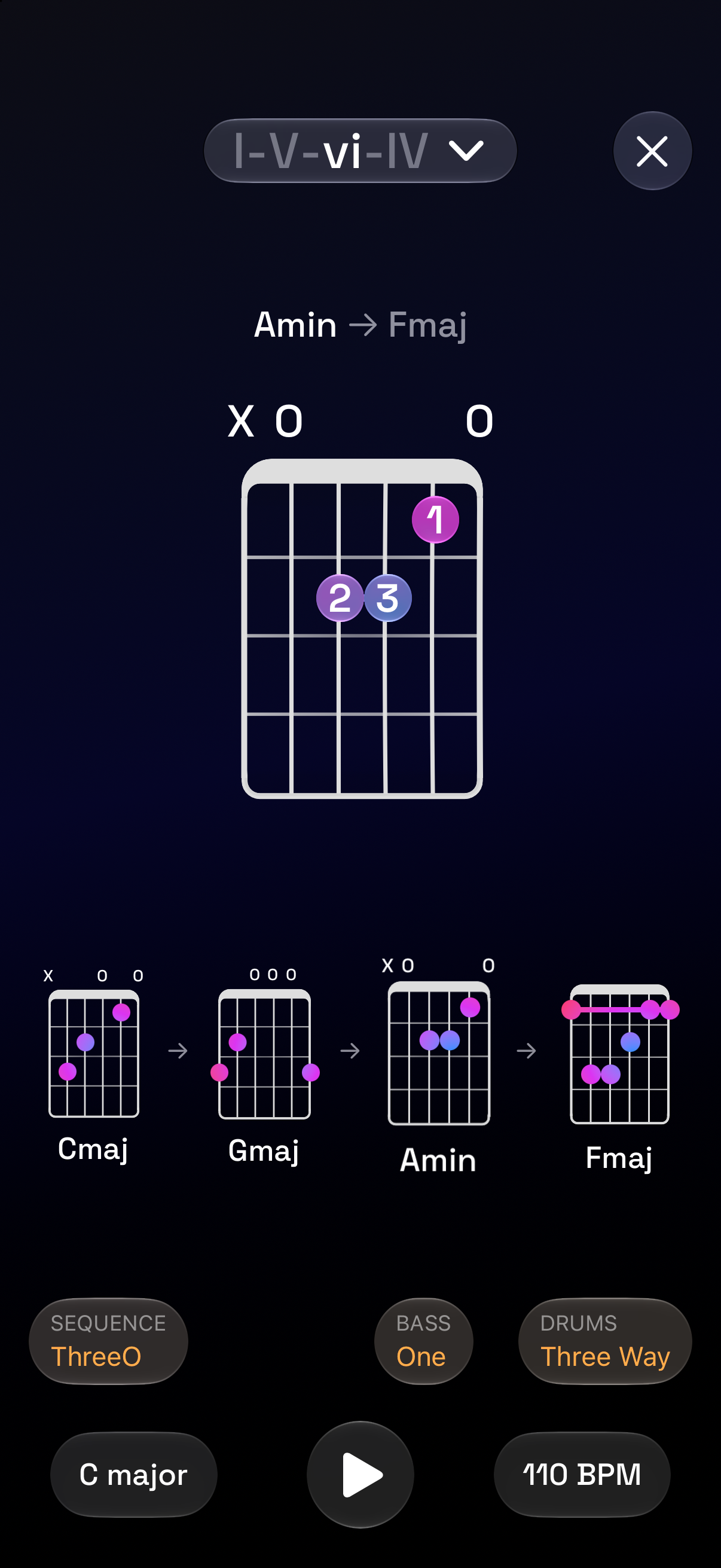
For example, I–V–vi–IV becomes C–G–Am–F in C major. Listening to the sequence reveals how the movement between chords creates its familiar character. Our I–V–vi–IV guide explains the pattern in more detail.

Choose shapes you can move between

A progression is easier to play when the fingerings connect comfortably. Open a chord to inspect its notes and positions, then compare a nearby voicing with one you already know. The goal is a smooth musical phrase, not simply a different diagram on every beat.

Use the guitar chord library for a closer look at the shapes and Chord Assist when a note sounds muted or unclear.

Turn a progression into your own practice track

Repeat a short sequence until you can make the changes evenly. Try a different strumming pattern, improvise a melody over the loop, or use Song Maker to develop your own arrangement with sections and instrument controls.

The same progression can support very different music depending on tempo, rhythm, and voicing. Browse common guitar chord progressions for more examples and practice ideas.

Related Questions

What are the most common chord progressions in pop music?

The most common pop progression is I-V-vi-IV (like C-G-Am-F in the key of C). It appears in hundreds of hit songs because it sounds satisfying, familiar, and emotionally engaging.

Other popular progressions include I-vi-IV-V (the 1950s progression), vi-IV-I-V (used in many modern pop songs), and I-IV-vi-V. Learning a handful of these patterns gives you the framework for most popular music.

Guitar Wiz includes a library of chord progressions organized by genre and mood, with audio previews so you can hear how each progression sounds.

What is a chord progression?

A chord progression is a sequence of chords played in a specific order. It forms the harmonic foundation of a song - the backdrop over which melodies, riffs, and solos are played.

Progressions are usually described using Roman numerals relative to the key. For example, I-IV-V in the key of G means G-C-D. This system makes it easy to transpose progressions to any key.

Guitar Wiz includes a library of chord progressions organized by genre and mood, so you can discover and practice the patterns behind your favorite songs.

What is the I-IV-V chord progression?

The I-IV-V (one-four-five) is the most fundamental progression in Western music. It uses the first, fourth, and fifth chords of a major scale. In the key of C, that's C-F-G.

This three-chord pattern drives thousands of songs across blues, rock, country, and folk. It works because the IV and V chords create natural tension that resolves back to the I chord, giving the progression a satisfying circular feel.

Explore the I-IV-V and its variations in Guitar Wiz's chord progressions library, complete with audio previews in multiple keys.

What is the 12-bar blues progression?

The 12-bar blues is a 12-measure chord pattern using the I, IV, and V chords. The standard form is: I-I-I-I, IV-IV-I-I, V-IV-I-V. It repeats continuously throughout the song.

This progression is the backbone of blues, early rock and roll, and jazz. Countless classic songs - from Robert Johnson to Led Zeppelin - are built on 12-bar blues.

Guitar Wiz's chord progressions library includes the 12-bar blues in every key, so you can practice this essential pattern with audio backing.

How do I write my own chord progressions?

Start by choosing a key. Write out the chords in that key (e.g., in C major: C, Dm, Em, F, G, Am, Bdim). Then experiment with different orderings, starting and ending on the I chord.

A helpful approach is to borrow from proven formulas. Take a progression you like, change one chord, and see how it sounds. Or start with a mood - happy progressions tend to use major chords, while moody ones lean on minor chords.

Guitar Wiz's Song Maker lets you select chords and hear them played back with accompaniment, making it a great sandbox for writing progressions.

Related Articles

Get access to Chord Progressions

Download on the App Store